
Rosetta was the bridge.
It is being taken down.
Apara gives Windows software an explainable, reversible home on Apple Silicon. Drop in an .exe. It reads the binary, shows you the plan in plain language, then runs it in an isolated environment you can roll back.
There is no live Kickstarter yet and nothing on this page takes payment. This is the campaign’s home; the campaign itself comes later.
Why this, why now
Every Mac gaming tool you use today is running on borrowed time.
A Windows game expects Direct3D, an x86 processor, and a Windows filesystem. An Apple Silicon Mac has none of them. The tools that bridge that gap today solve the processor half the same way: they run an x86-64 build of Wine, and let Rosetta translate it.
That works well today. What it does not do is survive macOS 28 with any certainty. At that point a Mac needs something that is natively arm64 and can still execute x86-64 game code.
Apple has said a subset of Rosetta stays, for older unmaintained games built against Intel frameworks. Worth being precise about what that is: a narrowed remnant for abandoned software, not a commitment to keep translating a maintained, general-purpose x86-64 Wine. Nobody outside Apple knows which side of that line a compatibility layer falls on, and an undocumented exception is not a foundation to build a product on.
Apara has that running now: an arm64-native Wine carrying a documented patch series, x86-64 guest code executed through FEX rather than Rosetta, Direct3D 11 through DXVK over MoltenVK, and Direct3D 12 at feature level 12_0 through vkd3d over KosmicKrisp. It is not finished. It is real, and it is measured.
What funding is actually for. The hard research is done and documented. What money buys is the distance between “the developer can reproduce this” and “a stranger can install it and it works”: compatibility coverage across many more titles, the support and release engineering a real product needs, and the time to do it without a day job.
Measured, not promised
What runs today — and what honestly does not.
One rule governs this page: measure, do not infer. Every row below is the result of running the actual binary and reading a result off it. The walls are here too, because a compatibility project that only publishes its wins is not telling you anything useful.
| Direct3D 11DXVK over MoltenVK | Measured |
| Direct3D 11 & 12User-supplied D3DMetal overlay | Measured |
| Direct3D 12 on arm64vkd3d over KosmicKrisp — feature level 12_0, Shader Model 6.5, tiled resources tier 2, on an M4 | Measured |
| Direct3D 9 / DirectDrawDXVK and wined3d | Measured |
| Native Vulkanwinevulkan to MoltenVK, no DXVK in the path | Measured |
| Audio and inputXAudio2 to FAudio to CoreAudio; controller and keyboard | Measured |
| Unreal Engine 3, 4, 5One measured title per generation | Measured |
| Source, Source 2, Unity, .NET/FNAOne measured title per engine | Measured |
| iPhone, nativeResearch on an iPhone 17 Pro, no streaming: Wine and an x86-64 translator run inside one app, Counter-Strike 2 loads its modules, draws its first frame through Direct3D-to-Metal and plays sound. Reaching the menu or a match is not yet claimed. | In progress |
| Installer formatsMSI, NSIS, Inno Setup and custom bootstrappers, each with a committed profile | Measured |
| PC storefrontsSeveral install and sign in on the x86-64 runtime. Coverage on the arm64 runtime is narrower and is being closed title by title. | Partial |
| Userspace anti-cheatOne family reached character select on a cold environment, then failed on every relaunch. Recorded honestly as a partial result. | Partial |
| 32-bit Windows programs on arm64Blocked with a stated reason. A migration path between runtime architectures exists for 64-bit programs. | Boundary |
| Kernel anti-cheatVanguard, BattlEye, EAC, Javelin, Ricochet. Refusals are recorded with evidence, never bypassed. | Boundary |
Why there is no list of playable games on this page. Individual titles have been investigated and each carries its own caveats — a specific graphics route, a specific launch path, a specific runtime build. Flattening those into a logo wall would turn measured work into an implied promise about your library, on your Mac. The per-title evidence is published as compatibility profiles keyed to build hashes, and that is the honest form for it.
Read this before you pledge
The things Apara will not do.
These are not temporary gaps waiting on more funding. They are architectural, and money does not move them. If one of them is the reason you would back this, please do not.
Kernel anti-cheat
Vanguard, BattlEye, EAC, Javelin and Ricochet require a kernel driver macOS will not load. Valorant, GTA Online, Apex Legends, Fortnite and their peers do not run, and Apara will not bypass or spoof an anti-cheat to make them.
D3DMetal is yours, not ours
Some of the best Direct3D results come through Apple’s D3DMetal. Apara cannot and will not redistribute it. You supply it from your own Game Porting Toolkit installation, or you take the DXVK route instead.
No universal compatibility
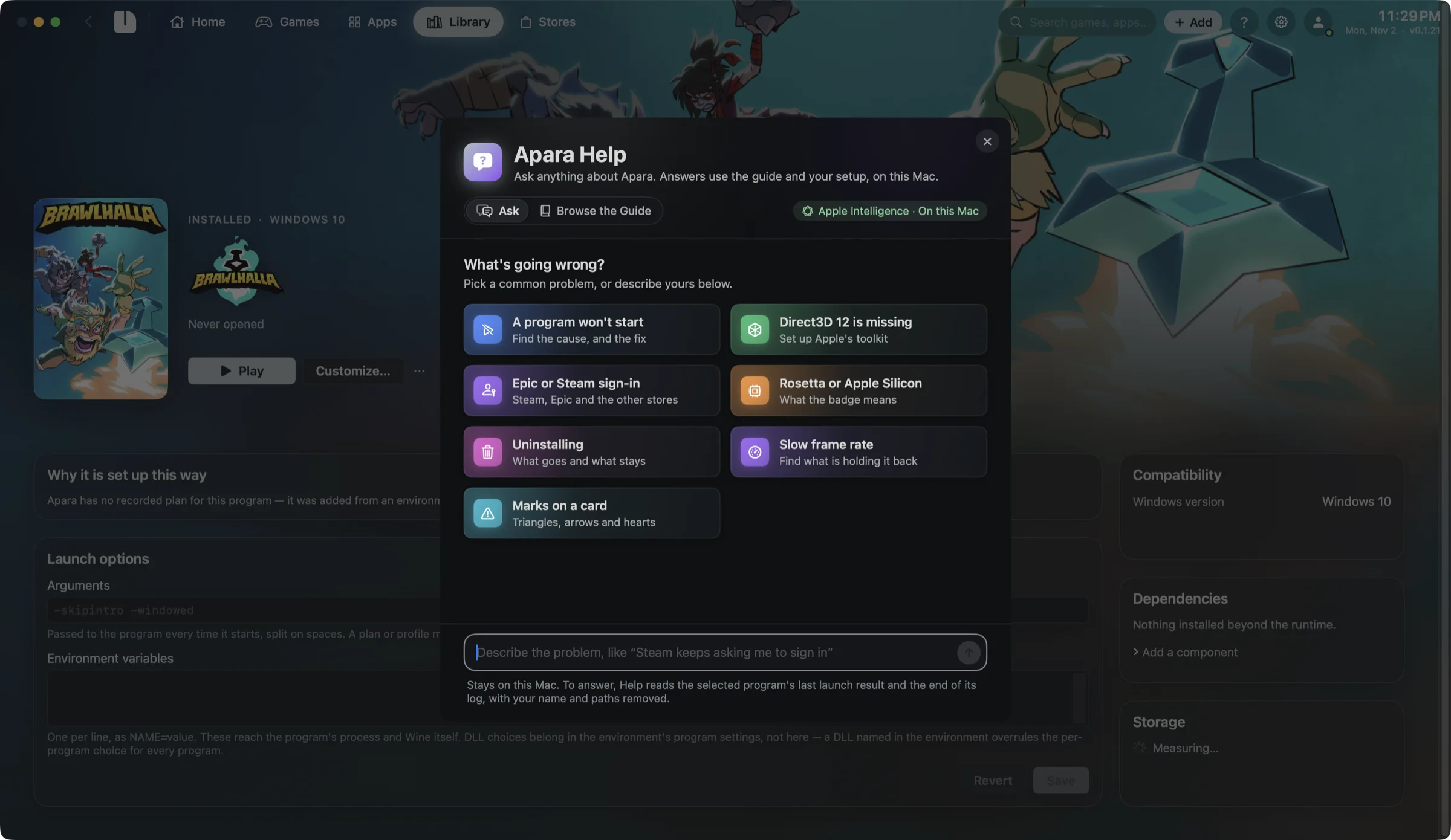
Apara will never claim your Steam library works. It claims that it reads a program, explains what it will do, and tells you when it cannot help — before a 90 GB download rather than after.
Apple Silicon only
There is no Intel Mac build and there will not be one. The entire architecture is built around what comes after Rosetta.
32-bit programs on arm64
Older 32-bit Windows programs cannot start under the arm64 runtime. Apara detects this and says so with a reason instead of failing halfway through an install.
No public release yet
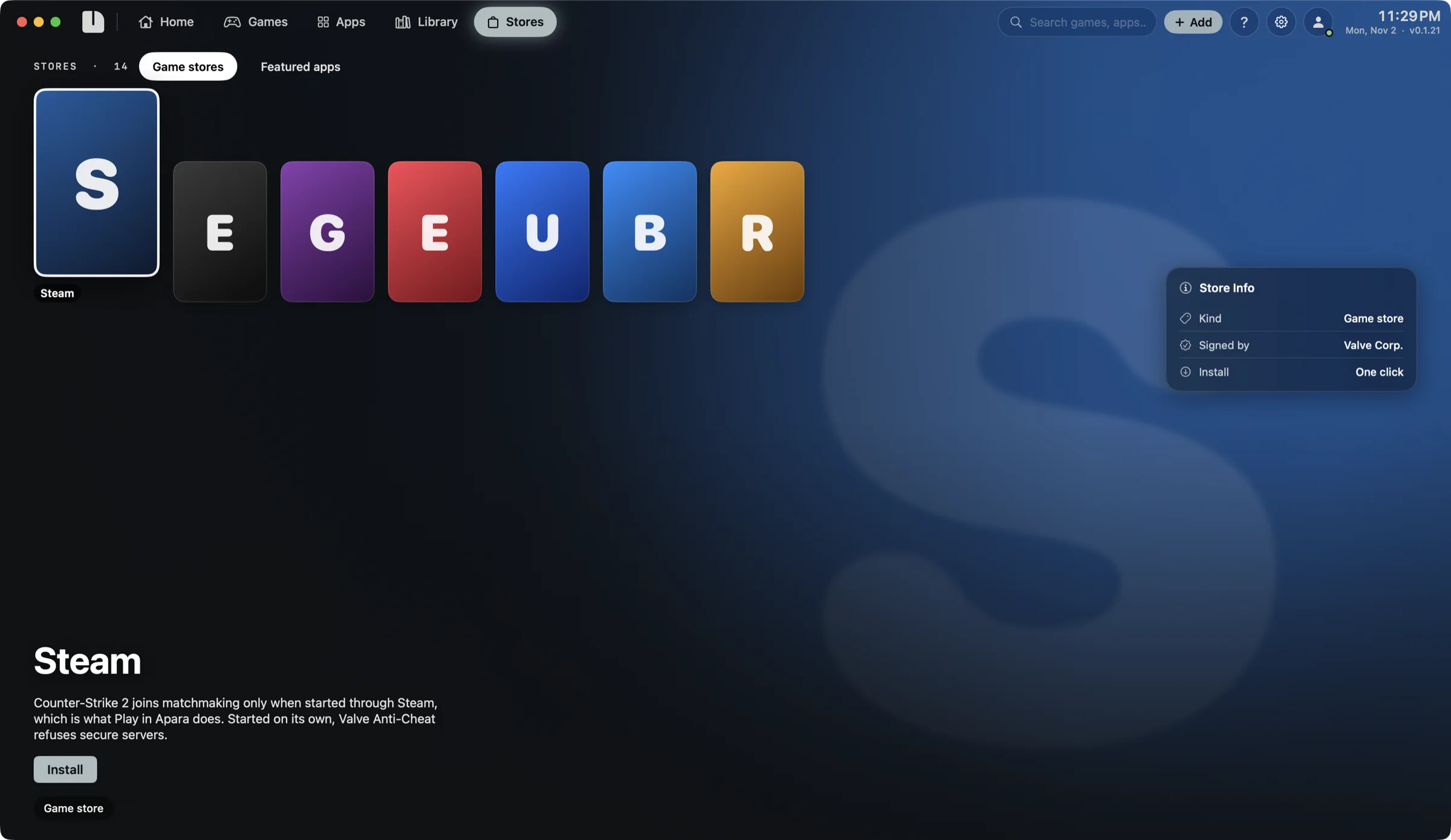
There is no download button on this page. The Mac app is signed and notarised, but it is not published, and a funded campaign is what turns a working development build into something a stranger can rely on.
The architecture
Six responsibilities, and nothing hidden between them.
Other tools treat the result as a black box: a folder some translation layer wrote into, impossible to reason about. When a game breaks after an update you cannot tell what changed, cannot roll back, and cannot reproduce a fix.
The binary is read first
Architecture, imports, instruction use, dependencies, storefront signatures and anti-cheat signals — before anything is installed.
Every decision is recorded
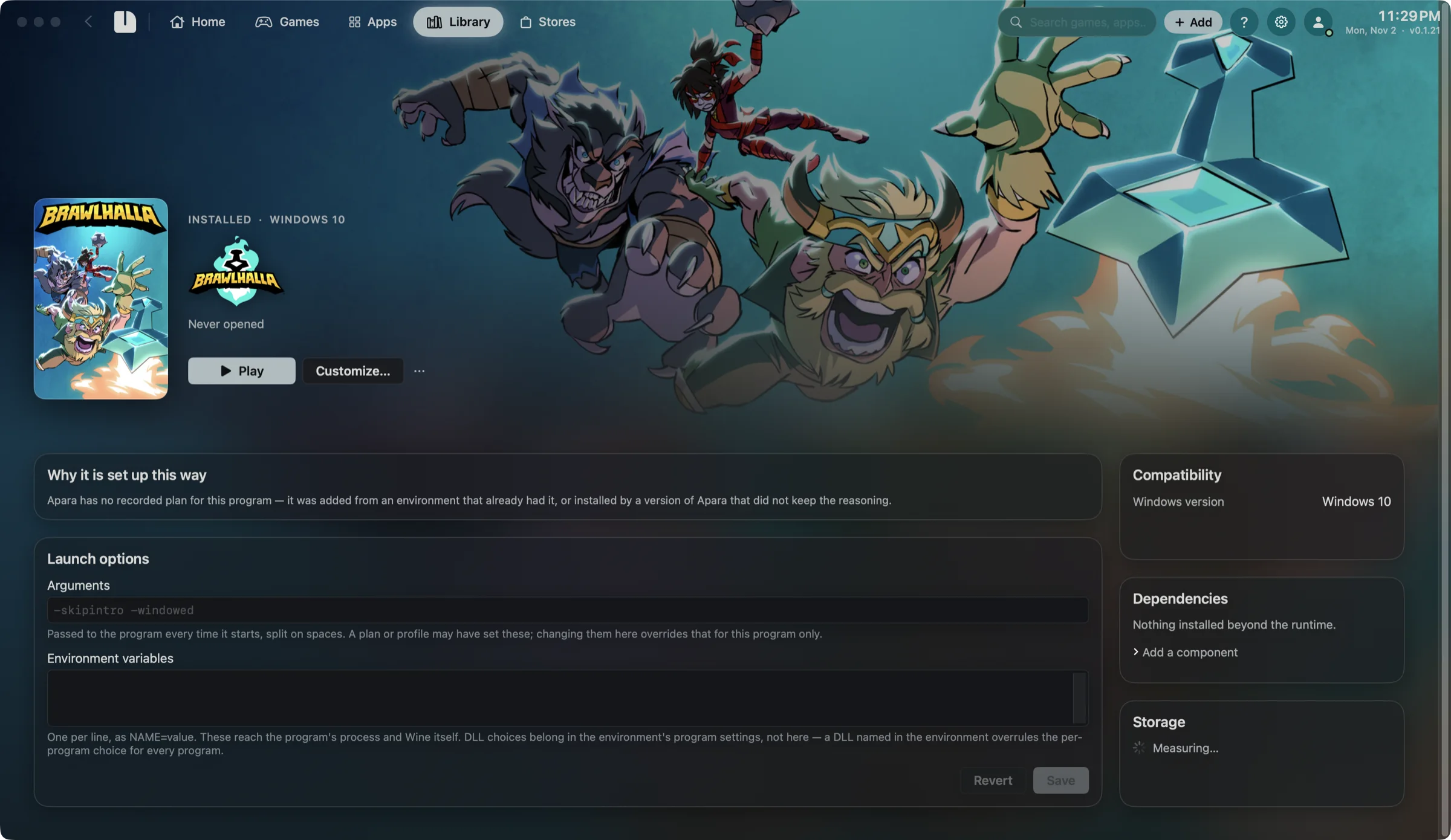
Runtime, graphics route, confidence, caveats and blockers, with the reasoning attached. You read the plan before it touches your Mac.
Pinned by content hash
A configuration that works keeps working. Apara does not silently move a program onto the newest runtime because it is newer.
Direct3D becomes Metal
Per-executable graphics choices inside one environment, so two programs that need different routes can share a launcher.
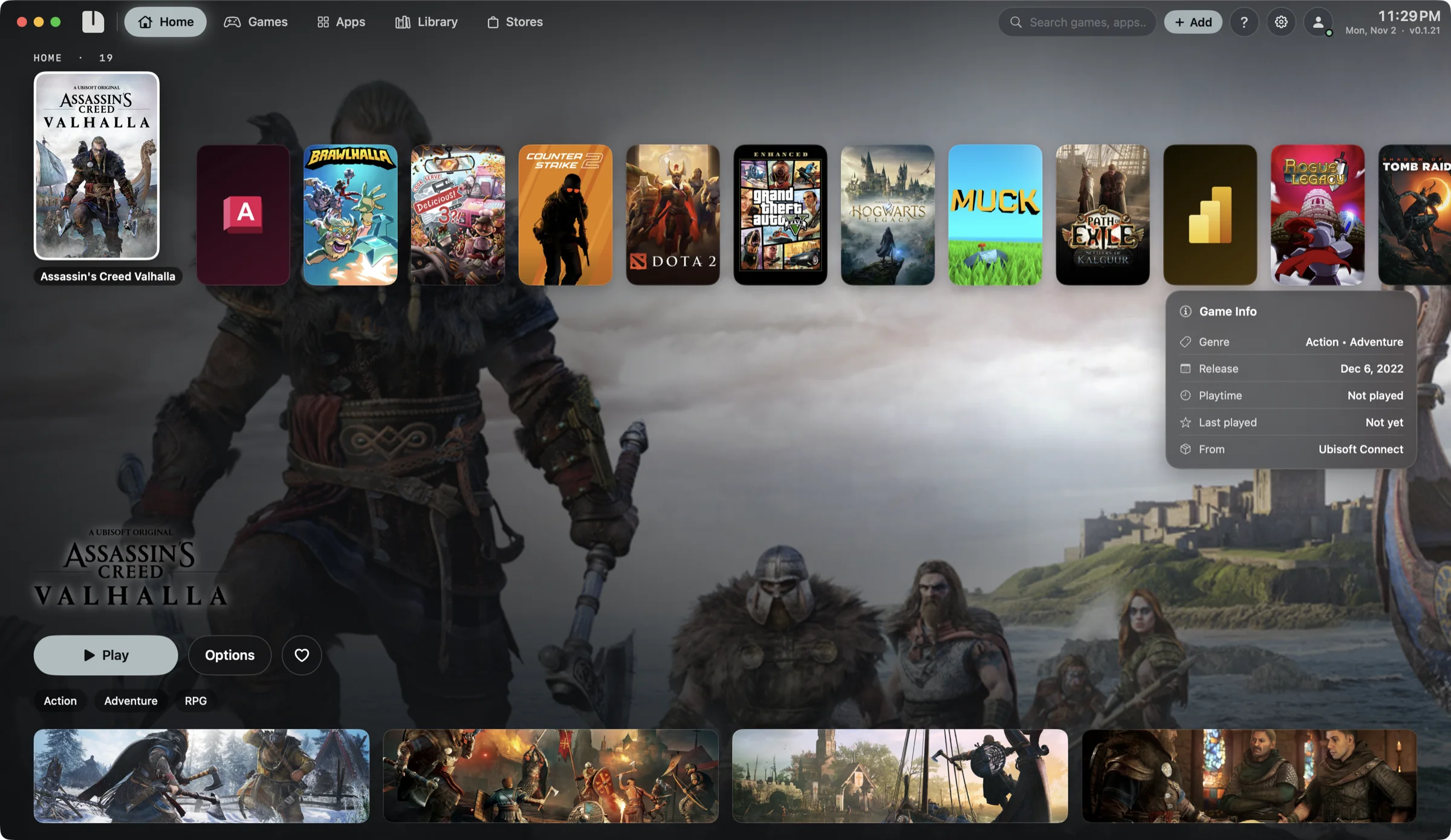
A native Mac window
Isolated, case-sensitive APFS environments with visible file-access rules. Host access is deny-by-default.
Recovery is ordinary
Risky changes get a checkpoint first. Going back to a known-good state is a normal thing to do, not an emergency.
What funding buys
From “it reproduces here” to “it works for you”.
Ordered by what unblocks the most people. Everything below is an estimate, and estimates on software projects move. When one moves, it will be said out loud in a backer update rather than quietly rewritten.
Private testing
A small, hand-picked cohort on real hardware, with a direct line to the developer. This is running before the campaign, not after it.
Compatibility coverage
More titles investigated and published as profiles, weighted toward what backers actually own. Coverage is the work; everything else is plumbing around it.
Release engineering
Updates, crash reporting, diagnostics a stranger can send, and a support path that is not one person answering DMs at midnight.
Staying ahead of macOS
Each macOS release moves the ground underneath this. The arm64 runtime has to keep working through macOS 28 and past it, which is continuous work rather than a milestone.
Back the project
Rewards.
After launch, Apara is a subscription. Kickstarter tiers buy that access up front at a discount, plus one lifetime tier that is not sold again after the campaign.
- Your name in the in-app credits
- The backer development journal — the real engineering write-ups, including the failures
- No licence included
Est. delivery: at campaign close
- One year of Apara Pro from public release
- Private beta access
- Everything in Supporter
Est. beta: during the campaign
Est. release: see the FAQ
- Two years of Apara Pro
- A vote on which titles are investigated next
- Everything above
Est. beta: during the campaign
Est. release: see the FAQ
- Three years of Apara Pro
- Roadmap vote and private beta
- Everything above
Est. beta: during the campaign
Est. release: see the FAQ
- Apara Pro for the life of the product, never billed again
- Your name in the founders list
- Roadmap vote and private beta
- Kickstarter-exclusive and limited
Est. beta: during the campaign
Not offered after the campaign closes
- Lifetime Apara Pro
- Nominate one single-player title you own; it gets a published compatibility investigation
- Best effort, and the result is published whatever it is — including “this does not work, here is why”
- Kernel anti-cheat titles cannot be nominated
Est. profile work: begins after public release
- Everything in the lifetime tier
- A one-to-one call with the developer on architecture and roadmap
- Prominent thanks in the app and the repository
Est. call: scheduled after the campaign
Nothing on this page takes payment. There is no live Kickstarter project yet. When there is, this page will link to it and these tiers will be the ones on it. Prices, limits and delivery estimates may change before the campaign opens, and any change will be stated here rather than quietly applied.
Before any of that
Test it now, and tell me what breaks.
The most useful thing anyone can do right now is not money. It is fifteen minutes on a call about what you have tried to run on your Mac and where it fell over.
If you have an Apple Silicon Mac and a Windows program you have wanted to run on it, get in touch. No install required, nothing to buy, and no obligation to say anything nice afterwards. If you would rather have a build in your hands than a conversation, say so and you go on the tester list.
Questions worth asking
FAQ.
Will my game work?
Honestly: maybe, and Apara is built so you find out cheaply rather than expensively. It reads the program first and tells you what it expects to be able to do, including when the answer is no.
If your game uses kernel anti-cheat, the answer is no and it will stay no. If it is a 32-bit program, it will not run on the arm64 runtime. Everything else depends on the specific title, and the only honest answer is a measurement.
How is this different from CrossOver or Whisky?
Two ways. First, the architecture: those run an x86-64 Wine under Rosetta. Apara runs a native arm64 Wine and executes x86-64 game code through FEX, which is the approach that survives macOS 28.
Second, the philosophy: Apara treats the environment as a described artifact with a recorded plan, pinned runtimes and rollback checkpoints, rather than a folder you hope nobody touches. Both of those tools are good and this project owes a lot to the work behind them.
When will it actually be released?
A date is not being published here, because publishing one before the campaign is planned would be inventing it. The tiers carry delivery estimates and the campaign will carry a release estimate; both will be marked as estimates and updated out loud when they move.
What can be said today: the Mac app is signed with a Developer ID and notarised by Apple, private testing is starting now, and there is no public download.
What happens if the campaign does not fund?
Development continues, more slowly. This project existed before the campaign and the research is already done and documented. Funding changes the pace and the support level, not whether the work happens.
Is this legal? Is it piracy?
Apara runs software you already own, on hardware you already own. It does not circumvent DRM, does not defeat anti-cheat, does not bundle or fetch publisher artwork, and refuses titles that require kernel anti-cheat rather than working around them.
It is not affiliated with Apple, CodeWeavers, the Wine project, or any game publisher or storefront.
What does “lifetime” actually mean?
Apara Pro for as long as the product exists, with no further billing. It is offered once, during the campaign, in limited quantity, and it is priced so that it funds its own maintenance rather than borrowing against future subscribers.
It is not a promise that the product exists forever. No one can honestly promise that, and a tier that implied it would be the least trustworthy thing on the page.
Who is building this?
One developer, working in the open, with the engineering documented as it happens. The GitHub organisation is the front door.
Back the work, not the promise.
Every claim on this page is a measurement. Every boundary is named.